
DevOps platforms are pivotal in how organizations deliver applications and services. The 2024 Gartner Magic Quadrant for DevOps Platforms offers a comprehensive look at the current state of the market, highlighting key players, emerging trends, and the driving factors behind the widespread adoption of these platforms.
As software delivery complexity increases, organizations are turning to integrated DevOps solutions to streamline processes, reduce tool friction, and accelerate time to value. This article dives into the report’s most important insights, helping you understand how the DevOps landscape is shifting and what it means for businesses worldwide.
Introduction to DevOps Platforms
At its core, DevOps is about improving the collaboration between software development and IT operations, enabling faster, more reliable software delivery. A DevOps platform is designed to integrate all the necessary tools and processes into a unified environment, from coding and testing to deployment and monitoring. According to the report, by 2027, 80% of organizations will incorporate a DevOps platform into their tooling to reduce complexity, up from just 25% in 2023. This explosive growth signals a major shift in how businesses approach software delivery, emphasizing the importance of agility, automation, and collaboration.
What Defines a DevOps Platform?
The Gartner Magic Quadrant defines a DevOps platform as providing fully integrated capabilities for continuously delivering software using Agile and DevOps practices. These platforms span the entire software development lifecycle (SDLC) and include version control, testing, security, and compliance functions. By consolidating these capabilities into a single environment, DevOps platforms help teams work more efficiently, reducing the cognitive load that often comes with managing complex toolchains.
Key Players in the DevOps Space
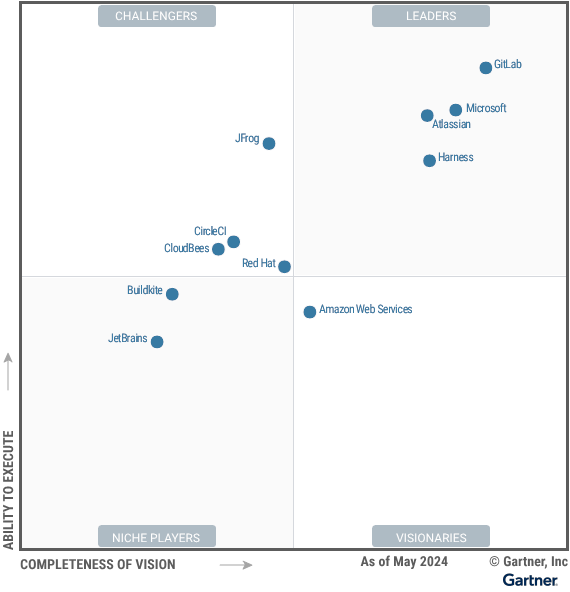
The 2024 Gartner Magic Quadrant identifies several key players in the DevOps platform space, categorizing them into Leaders, Challengers, Visionaries, and Niche Players.
Leaders: Atlassian, GitLab, Harness, and Microsoft
- Atlassian stands out for its deep integration between work management and software development tools, such as Jira and Bitbucket. The platform’s recent enhancements to DevSecOps capabilities and internal developer portals (like Compass) make it a strong choice for organizations focused on agile work management.
Check out the Getint integrations solution for Atlassian’s Jira.
- GitLab, with its continuous innovation and integrated security features, remains a dominant force in the DevOps space.
Find out more about Gitlab integration
- Harness is known for its strong cloud-native capabilities and continuous delivery pipelines.
- Microsoft provides two independent platforms—Azure DevOps and GitHub. With GitHub leading the charge, Microsoft leverages its massive developer community and generative AI capabilities to streamline DevOps workflows.
Challengers and Visionaries
While CircleCI, CloudBees, and JFrog are categorized as Challengers, they continue to offer competitive DevOps platforms. CircleCI excels in test automation and ease of use.
Visionaries like Amazon Web Services (AWS) focus on innovation. AWS’s CodeCatalyst shows promise by integrating tools like Elastic Kubernetes Service (EKS) and Terraform.
The Value of DevOps Platforms
Reducing Complexity
One of the biggest challenges in modern software development is the complexity of managing a diverse set of tools. DevOps platforms simplify this process by providing an integrated environment where all tools work seamlessly together, reducing friction and enabling faster software delivery.
Improving Collaboration
DevOps platforms are designed to foster better collaboration across teams. By providing a single source of truth for everything from code to deployment metrics, these platforms ensure that everyone is working with the same data.
Enhancing Security and Compliance
Security is an integral part of the DevOps lifecycle. GitLab and JFrog have made significant strides in embedding security checks, compliance, and governance into their DevOps workflows.
Accelerating Time to Market
By automating repetitive tasks and streamlining workflows, DevOps platforms significantly reduce the time it takes to bring new features and updates to market.

Emerging Trends in DevOps
Platform Engineering and Internal Developer Platforms (IDP)
Platform engineering is emerging as a critical discipline within DevOps. Internal developer platforms (IDPs) allow organizations to create self-service environments where developers can access the necessary tools and infrastructure without relying on centralized IT teams. Atlassian’s Compass and Harness’s Internal Developer Portal are examples of how vendors respond to this trend.
AI and Machine Learning in DevOps
AI is playing an increasingly important role in DevOps, helping to automate processes such as testing, security scanning, and infrastructure management. GitHub Copilot leverages generative AI to assist developers in writing code, while Harness’s AI capabilities help identify and remediate vulnerabilities.
Multicloud and Hybrid Cloud Environments
As organizations adopt multicloud and hybrid cloud strategies, DevOps platforms are evolving to support the complexity of managing applications across different environments.
Key Takeaways and the Path Forward
The 2024 Gartner Magic Quadrant for DevOps Platforms clearly shows the future of DevOps. Leaders like Atlassian, GitLab, and Microsoft are setting the pace while challengers and niche players continue to provide specialized solutions.
Enhancing Cross-Platform DevOps Workflows with Getint
In the world of DevOps, ensuring smooth workflows across multiple platforms can be challenging. Getint addresses this challenge by providing powerful integration tools and bridging platforms like Jira, GitLab, Azure DevOps, Clickup or GitHub.
"This report shows, that there are many great solutions on the market. And that there is none, that is perfect for everyone - there is no silver bullet. That’s why, oftentimes organizations decide to use Atlassian’s Jira, Azure DevOps and GitLab alongside each other, integrating them. That’s why we created Getint, to make sure that every team can work together, while using their preferred tool" - Jacek Wizmur, Co-Founder of Getint
Getint supports the integration of DevOps platform leaders with APMR tools to further improve workflows throughout the organization. By offering bi-directional, automated data synchronization, Getint eliminates manual handoffs and reduces the friction that often arises when using multiple systems.
Teams looking to bridge their development and project management workflows can benefit from a dedicated Jira Azure DevOps integration that synchronizes issues, work items, and statuses automatically. Getint’s Jira-Azure DevOps connector supports bidirectional sync with field mapping, filters, and no-code setup.