
In IT Service Management (ITSM), teams handle service disruptions in different ways depending on urgency, impact, and long-term risk. Some situations require immediate action to restore normal services, while others demand deeper investigation to prevent the same, identified problem from happening again.
This is where incident management and problem management come into play. Although these practices are closely connected, they are designed to solve very different types of challenges within an IT environment. Confusing one for the other often leads to recurring incidents, unstable systems, and unnecessary service disruptions.
In this article, we’ll explain the difference between problem management vs incident management, show how each process works, and clarify when IT teams should use one instead of the other. We’ll also look at how these ITIL processes support long-term stability in modern IT services, including how platforms like ServiceNow structure incident and problem workflows.

How Incident Management Works
Incident management begins when an unplanned interruption affects normal services. This may be a system outage, degraded performance, data loss, or an urgent issue impacting users, applications, or mobile devices. The primary objective is straightforward: restore services as quickly as possible and minimize disruption to business operations.
The incident management process is intentionally reactive. It prioritizes speed and impact reduction over investigation. Service desk teams and incident managers work within a formal process to ensure incidents are handled consistently and in line with service level agreements (SLAs).
Typically, incident management involves:
- logging and documenting the incident
- categorizing and prioritizing based on urgency and impact
- coordinating IT teams to resolve the issue
- communicating updates to users
- restoring normal services as quickly as possible
Once services are restored, the incident is usually closed. At this point, the issue may be fully resolved or only temporarily fixed. Incident management may identify symptoms or contributing factors, but it does not require full root cause elimination. Its success is measured by response time, incident volume, and how effectively service disruption is minimized.
How Problem Management Differs
Problem management comes into focus when organizations realize that resolving incidents alone is not enough. Recurring incidents, similar incidents across systems, or repeated system outages often indicate deeper underlying issues within the IT area.
Generally speaking, unlike incident management, problem management focuses on why incidents happen, not just how to fix them quickly. The goal is to identify the root cause behind one or more incidents and implement a long-term solution that prevents futher disruptions.
Problem management team processes typically include:
- analyzing incident data and trends
- performing root cause analysis
- identifying known errors
- documenting workarounds and permanent fixes
- reducing the likelihood of future incidents
Problem management takes a more proactive approach. Through trend analysis, knowledge base development, and continuous improvement, it helps IT teams reduce incident volume over time, avoid future incidents, and improve long-term service stability.
Key Differences Between Incident vs Problem Management
Although incident management and problem management are closely related, they are designed to answer very different questions. Incident management asks how to restore services quickly, while problem management asks why the disruption happened in the first place.
Incident management is concerned with immediate impact. When a service disruption occurs, the priority is to restore normal services and minimize business impact. This often means applying temporary fixes or workarounds so users can continue their work, even if the cause remains unresolved.
Problem management, on the other hand, takes a broader and more analytical view. It focuses on identifying underlying issues that cause incidents to recur. Rather than reacting to a single unplanned event, problem management looks across one and more incidents, searching for patterns that indicate systemic weaknesses in the IT sector
In practical terms, incident management is time-critical and reactive, while problem management is analytical and proactive. Both processes are essential, but they operate on different timelines and serve different objectives within IT services.
Incident Management vs Problem Management: Process Comparison
The distinction becomes clearer when comparing how each process operates in day-to-day IT operations.
Incident management typically starts with a one unplanned event — such as a system breakdown, application failure, or service degradation — that interrupts normal services. The incident management process is designed to be fast and predictable, enabling IT teams to restore services within defined SLAs.
Problem management usually begins after incidents have been resolved. When organizations identify recurring incidents, related incidents across systems, or increasing incident volume, problem management is triggered to investigate further. This involves a deeper investigation, often using root cause analysis, to determine whether a known error or structural issue exists.
While incident management may rely on a short-term tool or workaround, problem management aims to deliver a permanent fix that improves long-lasting stability and reduces future disruptions.
When to Use Incident vs Problem Management
Choosing the right process at the right time is critical for effective ITSM.
Incident management should be used when:
- a service disruption is actively impacting users
- restoring services quickly is the top priority
- the issue represents an urgent operational risk
- business actions are being interrupted
Problem management should be used when:
- similar situations occur repeatedly
- a temporary fix is applied multiple times
- the same issue affects multiple services or teams
- IT teams need to prevent future incidents
Not all incidents require problem management. However, recurring issues, unresolved root causes, and increasing incident volume are strong signals that a problem record should be created.
How Incident and Problem Management Work Together
In mature IT organizations, incident and problem management are not isolated processes. They form a continuous improvement loop.
Incidents provide valuable data. Each of them generates incident documentation, timelines, and resolution details that feed into problem management. When patterns emerge, problem management takes over to investigate the problem’s root cause.
Once a permanent solution is identified, it may require changes to systems, configurations, or processes. Those changes are then handled through change management, ensuring controlled implementation without introducing new risks.
This coordinated approach helps organizations:
- reduce service disruption
- avoid future incidents
- improve stability
- strengthen IT services over time
Incident vs Problem Management Approaches: Summary Table
To bring everything together, the table below summarizes the key differences between incident management and problem management in a clear, practical way. This high-level comparison helps IT teams quickly understand which process to apply in different situations.
This table reinforces a critical ITIL principle: incident management restores services, while problem management improves systems.
Incident and Problem Management in ServiceNow
ServiceNow clearly separates incident and problem management while allowing them to work together seamlessly. Incidents and problem tickets are treated as individual processes, each with its own workflows, roles, and performance indicators.
In ServiceNow:
- incidents focus on restoring services quickly
- problem records capture underlying causes
- known errors are documented for future reference
- trend analysis helps identify recurring issues
- knowledge base articles support faster incident resolution
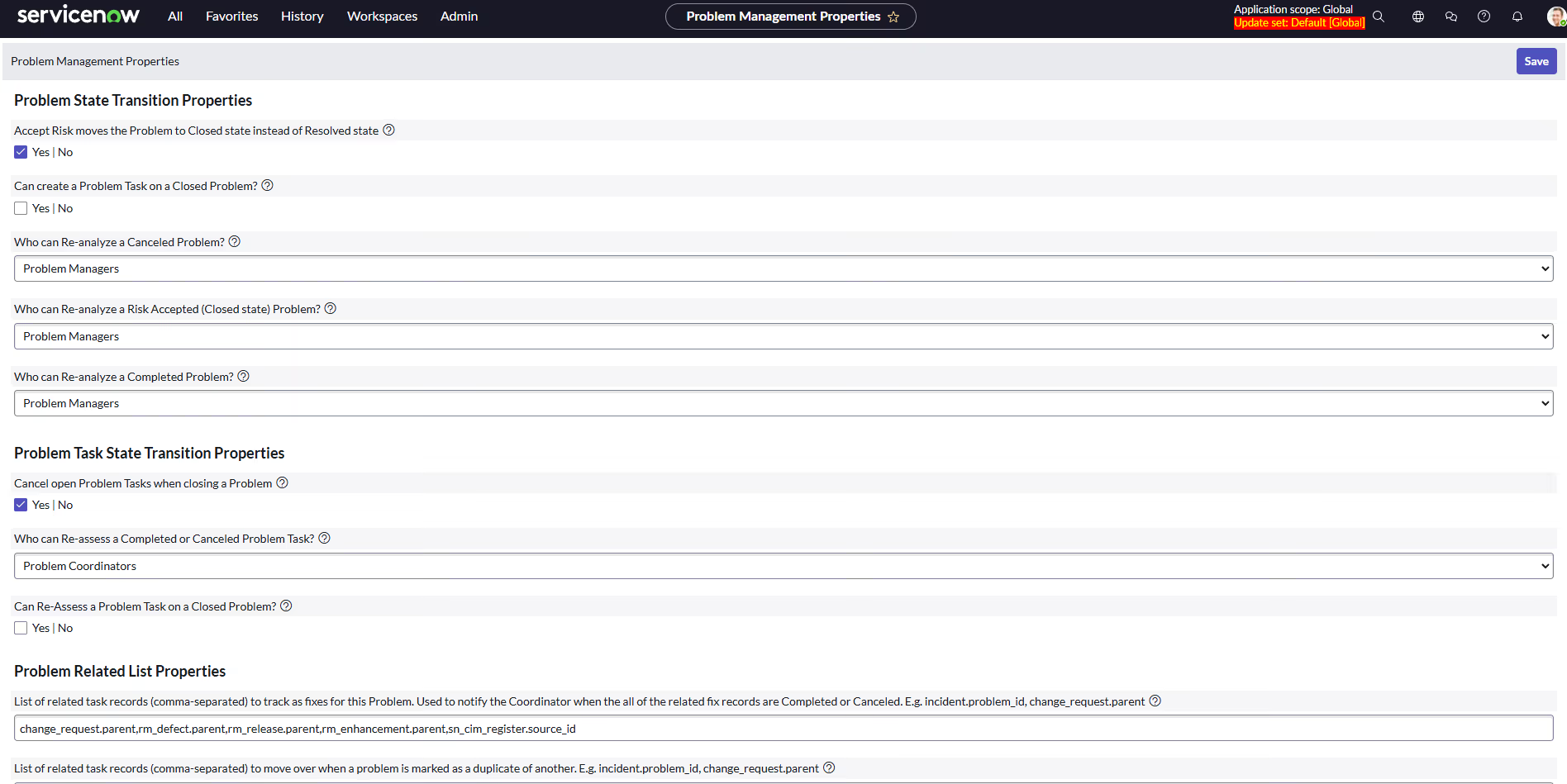
By linking incidents to problems, ServiceNow enables IT teams to move from reactive incident resolution to robust problem solving. This supports a more proactive stance, reduces future disruptions, and improves overall service quality, having a positive impact on key performance indicators.
Why the Difference Matters for Long-Term IT Teams Stability
Organizations that rely only on incident management often find themselves stuck in a reactive cycle. Services are restored quickly, but the same incidents return, incident volume grows, and IT teams spend more time firefighting than improving systems.
Problem management breaks this cycle. By investigating underlying causes and addressing systemic weaknesses, organizations can reduce future incidents, improve stability, and build more resilient IT services. This shift from reactive incident resolution to proactive problem management supports continuous improvement across the IT environment.
In platforms like ServiceNow, this distinction becomes even more important. When incidents, problems, and known errors are properly linked, IT teams gain visibility into how disruptions evolve over time. This enables better decision-making, clearer prioritization, and stronger alignment between operational support and long-term service improvement.
Conclusion
Understanding problem management and incident management is essential for any organization that wants to deliver reliable IT services at scale. While incident management focuses on restoring normal services after an unplanned slowdown, problem management looks deeper — identifying root causes and preventing similar incidents from occurring again.
Both processes are necessary. Well handled incident management protects day-to-day business operations and leads to increased customer satisfaction, while problem management strengthens long-term stability. Used together, they help IT teams minimize disruptions, avoid repetitive issues, and continuously improve resolution process.
For organizations operating within the ITIL framework or using ITSM tools like ServiceNow, clearly separating — and properly connecting — incident and problem management is a key step toward more resilient, efficient, and proactive IT operations.