
Introduction: The Perceived Conflict Between Agile and ITSM
IT organizations often perceive Agile and IT Service Management (ITSM) as fundamentally opposed. Agile practices emphasize speed, iterative delivery, and flexibility, while ITSM processes address control, risk mitigation, and operational stability.
The traditional narrative positions them as mutually exclusive: Agile values rapid experimentation and market responsiveness, while ITSM enforces predictable, structured processes. Many companies feel they must choose one or the other. As a result, operations and development teams often work in silos, creating fragmented reporting, poor incident management and resolution, or friction between change approval and deployment velocity.
However, modern enterprises require both speed and reliability. For example, a fintech company deploying daily updates while maintaining strict SLA compliance must deliver quickly without compromising production stability, and failing to meet customer expectations.
Expanded Narrative
At a global e-commerce company, initial attempts to adopt Agile without integrating ITSM resulted in repeated production outages during peak sale events. Development teams deployed new features daily, but incidents went untracked, CAB (Change Advisory Board) approvals were ignored, and customer-impacting bugs were resolved late. After introducing a hybrid model, including incident tracking, risk-tiered approvals, and SLA monitoring, the company reduced outage incidents by 50% while maintaining weekly deployments. This demonstrates the importance of blending Agile speed with ITSM governance.
The solution lies in hybrid operational models. By integrating Agile principles with ITSM frameworks through Jira, organizations can maintain rapid delivery while ensuring controlled, auditable operations.
Understanding the Core Philosophies
Understanding the limitations and benefits of Agile and ITSM is key to building an effective hybrid system.
Agile Principles
Agile is fundamentally a risk management strategy coping with market shifts, changing business, and product uncertainty.Its goal is to shorten the time between idea generation and validated business outcome.
Core principles include:
- Rapid iteration and faster delivery
- Continuous improvement and adaptation
- Cross-functional collaboration
- Incremental delivery of value
In practice, Agile success is measured not solely by speed but by learning velocity: how quickly teams can validate assumptions and incorporate regular feedback. Metrics such as deployment frequency, lead time, and velocity indicate how efficiently teams reduce uncertainty.
Example:
A software development team deploying feature updates twice a week tracks:
- Customer feedback incorporated in subsequent sprints
- Percentage of features delivered without defects
- Predictability of sprint outcomes across interdependent teams
Agile assumes change is inevitable. Therefore, processes must quickly respond and adapt without compromising quality, and forgetting about customer centric approach.
Tip: Agile adoption should include education for ITSM teams to understand iterative delivery and adaptive planning. This reduces friction and fosters cross-team empathy.
ITSM Principles
IT Service Management practices consist of operational risk management, ensuring production systems remain stable and predictable.
Key objectives include:
- Maintaining service quality, reliability and SLA adherence
- Mitigating risk through structured change processes
- Ensuring compliance and audit readiness
- Providing repeatable, controlled workflows
ITSM metrics often include:
- Mean Time to Restore/Repair Service (MTTR)
- Change success rate
- SLA compliance percentage
- Audit pass rate
Example:
A banking infrastructure team implemented ITSM controls for security patch deployment. Initially, developers felt these were slow, but once IT Service Management processes were aligned with Agile sprints, security patches were deployed without affecting feature service delivery processes.
While the Agile approach reduces market risk, ITSM practices reduce operational risk. Integrating the two allows organizations to maintain speed without compromising service reliability or compliance requirements.
Most Popular Agile ITSM Frameworks
When organizations begin aligning Agile methodologies with IT Service Management, they often rely on structured frameworks to guide implementation. The most popular Agile ITSM frameworks provide practical ways to balance iterative delivery with operational control, especially when using Jira as the central platform.
Scrum
Scrum is one of the most widely adopted Agile frameworks. It structures work into time-boxed sprints, typically lasting two to four weeks, with defined roles such as Product Owner and Scrum Master.
In an Agile ITSM environment, Scrum helps teams:
- Plan operational improvements in structured iterations
- Allocate capacity for incident-driven unplanned work
- Maintain predictable delivery cycles while managing service stability
Scrum works particularly well when development and operations collaborate on structured sprint cadences.
Kanban
Kanban focuses on continuous flow rather than fixed-length sprints. Work items move across visual boards, with strict work-in-progress (WIP) limits to prevent overload.
For Agile ITSM teams, Kanban is especially effective because:
- Incidents and service requests can arrive unpredictably
- Work prioritization can shift dynamically
- SLA-driven tasks require continuous monitoring
Kanban aligns naturally with Jira Service Management workflows, allowing operational teams to maintain flexibility while preserving visibility and control.
SAFe (Scaled Agile Framework)
In large enterprises, the Scaled Agile Framework (SAFe) provides structure for coordinating multiple Agile teams across portfolios.
Within Agile ITSM environments, SAFe enables:
- Alignment between enterprise change governance and Agile release trains
- Coordinated deployment planning across regions
- Integration of risk-tiered change management into program increments
This is particularly useful for organizations operating multiple Jira instances across business units.
Lean IT
Lean IT focuses on eliminating waste, optimizing process efficiency, and improving service flow. It complements Agile ITSM by streamlining repetitive operational processes and reducing unnecessary approval bottlenecks.
Lean principles often support automation strategies within Jira, improving both SLA performance and deployment speed.
Choosing the Right Framework in Jira
There is no single best framework for Agile ITSM. Many organizations combine Scrum for structured delivery, Kanban for incident management, and Lean principles for operational optimization.
The key is not strict adherence to a framework, but designing workflows in Jira that reflect proportional governance, risk-tiered change management, and integrated operational visibility.
Where Agile Methods and ITSM Collide in Practice
In daily operations, friction between Agile practices and ITSM manifests in several ways.
Change Management vs Continuous Deployment
Agile teams deploy frequently, while traditional ITSM introduces multiple controls:
- CAB approvals
- Documentation layers
- Scheduled change windows
Rigid change processes delay deployment, slowing Agile velocity. Without any governance, production stability suffers. The solution is proportional governance: applying controls based on risk level.
Example:
Minor configuration changes can auto-approve, while critical updates affecting production require CAB review. This reduces bottlenecks and ensures production stability.
Lesson Learned:
Teams that fail to define risk-based controls often face a backlog of “urgent” changes that block development for weeks.
Incidents Disrupting Sprint Commitments
Production incidents often pull development teams from planned sprint work. This can result in:
- Sprint spillover
- Misleading velocity metrics
- Increased stress for team members
Unplanned work must be visible and allocated within sprint planning. Without this visibility, scrum teams and engineers cannot accurately measure productivity or deliver reliably.
Example:
An e-commerce platform had two sprints where more than 30% of planned work was delayed due to unplanned incidents. After introducing sprint buffers and linking incidents to JSM tickets, teams could plan capacity more accurately.
Reporting Fragmentation
Operational teams track MTTR, SLA compliance, and change success rates. Development teams track sprint velocity, throughput, and release cadence. When metrics are siloed:
- Leadership lacks a unified operational view
- Decision-making is based on incomplete data
- Strategic planning is misaligned
Integrating metrics allows executives to make informed trade-offs between speed and operational risk.
The Hybrid Model: Running IT Operations using Agile Methodologies
Hybrid models align Agile delivery and ITSM governance, creating synergy instead of conflict.
Structuring Service Work Without Losing Flexibility
Instead of rigid, linear workflows, Agile service management should adopt risk-tiered branching.
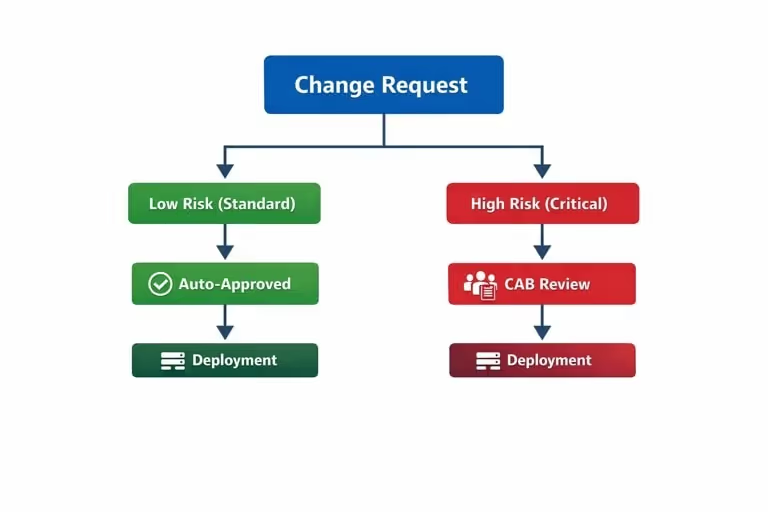
Low-risk changes can use pre-approved templates; high-risk changes follow CAB review. This proportional governance ensures Agile teams deliver efficiently while maintaining operational control.
Example Expansion:
An IT team managing a SaaS platform pre-approves database changes (low risk) but requires CAB approval for system-wide security updates. This ensures rapid delivery without risking production stability.
Integrating Incidents and Development Work
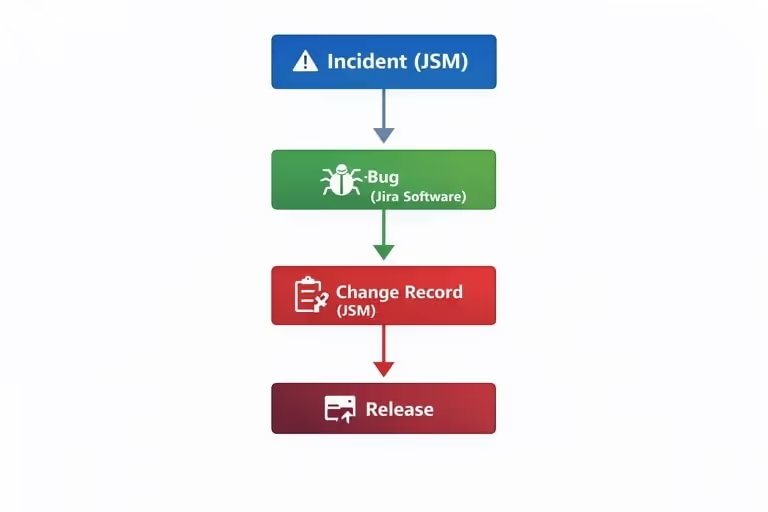
Operational incidents should be linked to development tasks:
Benefits:
- End-to-end root cause traceability
- SLA visibility and compliance
- Audit readiness
- Clear connection between operational and development outcomes
Narrative:
If a production outage occurs due to a bug, leadership can trace it back to the incident ticket, the applied code fix, and the corresponding release. This provides full transparency for both developers and operations teams.
Managing Unplanned Work Within Agile Cadence
Unplanned work should be structured and predictable. Teams should allocate capacity for incidents and operational tasks. Find an example column below:
Expanded Narrative:
Consider a SaaS platform experiencing unexpected traffic spikes during a new feature launch. Operations suddenly receive a surge of incident tickets for server latency, API timeouts, and database errors. Teams that had reserved a 20% buffer could respond immediately, resolving critical work items within the SLA. Teams without allocated buffers faced sprint spillover, delayed planned work, and increased stress. Lessons learned include incorporating historical incident trends into sprint planning, continuously refining buffer allocation, and reviewing recurring incidents to reduce operational risk.
Using Jira to Bridge the Gap
Jira is most effective when architected as an ecosystem.
Linking Jira and Jira Service Management
Separate Jira Service Management spaces handle operations, while Jira (formerly Jira Software) spaces handle product delivery. Structured linking between incidents, bugs, changes, and releases preserves accountability and enables full traceability. Shared components maintain ownership clarity without merging workflows unnecessarily.
Best practices:
- Dedicated JSM spaces for operations
- Jira spaces for delivery
- Structured linking of incidents → bugs → changes → releases
- Shared components and environment structures
Example:
A global company links incidents in one region to development tasks in another Jira instance, maintaining full traceability without manual duplication.
Workflow Alignment in Cross-Functional Teams
Mapping ITSM states to development equivalents ensures semantic consistency: "In Progress" maps to "In Development," "Awaiting Deployment" maps to "Ready for Release," and so on. Misalignment increases friction; deliberate mapping reduces it.
Automation as a Governance Accelerator
Automation can transition work items, pause SLA timers, and notify stakeholders. This reduces latency without sacrificing control and ensures audit readiness is embedded in real-time operations. Beyond overall efficiency, automation also enforces consistency across teams, ensuring that critical steps are never skipped, even under high-pressure situations. By reducing repetitive manual tasks, teams can focus on higher-value work, such as root-cause analysis or proactive risk mitigation. Over time, automated workflows create a culture of accountability, where process adherence is visible and measurable across all spaces.
Reporting Architecture
A unified Jira dashboard aligns operational and delivery metrics. It allows teams to see deployment frequency, MTTR, change failure rate, SLA compliance, and sprint spillover ratio together. Leaders can therefore balance speed and stability rather than managing them in isolation.
Getint ITSM Integrations in Multi-System Environments
In large enterprises, Jira rarely operates alone.
Many organizations integrate with:
- ServiceNow
- Azure DevOps
- GitHub
- GitLab
- Other Jira instances
Tools like Getint ITSM integrations allow organizations to create structured, many-to-many bridges between spaces across platforms.
Instead of:
- One-to-one work item sync
- Manual replication
- Fragmented status mapping
You can design:
- Many-to-many relationships
- Field-level synchronization
- Bidirectional status alignment
- SLA-aware syncing
This becomes critical when:
- Multiple Jira instances coexist
- Enterprise ITSM lives in one platform
- Dev teams work in another
Getint’s ITSM-focused integrations support architectural alignment across systems, ensuring operational and development visibility remains intact.
For organizations operating at scale, integration strategy becomes just as important as workflow design.
SLA Modeling & Reporting in Jira
Narrative Expansion:
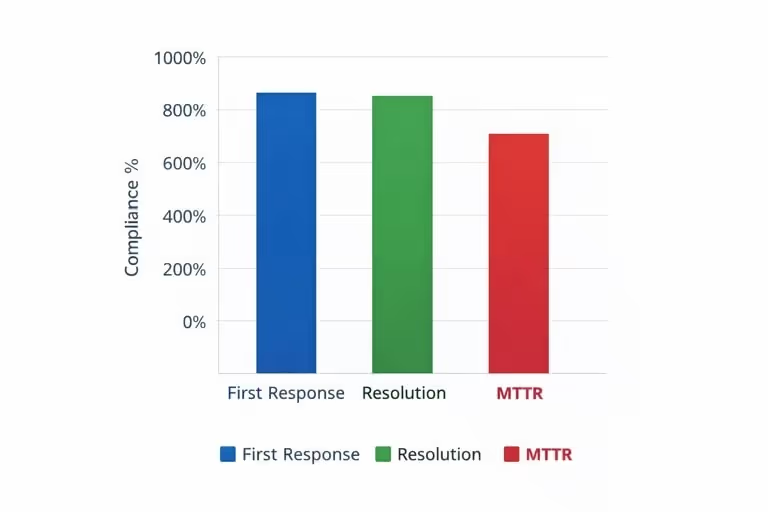
The first-response SLA triggers alerts if tickets are unacknowledged for more than one hour. Resolution SLAs ensure timely closure, while MTTR tracks recovery efficiency. Dashboards combine these with Agile KPIs for full operational visibility.
Enterprise Case Study: Scaling Jira Across Teams
A multinational financial institution faced:
- Multiple Jira instances
- Separate JSM spaces
- Fragmented operational metrics
Solution:
- Structured incident → bug → change linking
- Risk-tiered change governance with automation
- Unified dashboards for MTTR, deployment frequency, SLA compliance
Results:
- Deployment frequency ↑ 35%
- MTTR ↓ 40%
- Sprint spillover ↓ from 18% to 5%
Lesson Learned:
Structured Jira architecture enables measurable incremental improvements even in complex multi-team, multi-region environments.
Failure Scenario Walkthrough
Failure modes:
- Unlinked incidents: MTTR increases
- Overloaded approvals: Deployment delays
- Ignored metrics: Sprint velocity misrepresents progress
Mitigation: Workflow reviews, buffer allocation, automation, dashboards.
Governance Without Bureaucracy
Governance should scale proportionally to risk. Manual checks are replaced by automation where possible, and audit readiness is built into the workflow. Low-risk changes can be pre-approved, medium-risk undergo technical review, and high-risk require CAB evaluation. This proportional approach preserves agility while ensuring control.
Automation embeds audit readiness while maintaining lightweight governance.
Measuring Success in a Hybrid Model
Mature hybrid systems improve delivery speed and operational stability simultaneously. Metrics evolve as maturity increases: deployment frequency rises, MTTR decreases, change failure rate declines, and SLA compliance improves. Over time, speed and stability begin to correlate positively.
Example Narrative Expansion:
An enterprise implementing hybrid Jira linking observed that visibility into operational incidents allowed sprint planners to allocate resources more realistically, reducing spillover and improving overall release predictability.
Metrics improve as maturity rises: Deployment frequency ↑, MTTR ↓, change failure rate ↓, SLA compliance ↑.
Scaling Hybrid ITSM + Agile in Large Enterprises
Large organizations benefit from:
- Multi-team cross-space dashboards
- Centralized reporting with regional autonomy
- Structured integration across Jira instances
- Automated governance for repeated low-risk changes
Expanded Narrative:
At a global enterprise with 10,000 employees, multiple Jira instances existed across North America, Europe, and Asia. Operations teams needed to monitor incidents globally, while development teams deployed regional features independently. Without proper integration, duplicate tickets, inconsistent SLA tracking, and misaligned releases occurred frequently. By implementing a structured cross-instance integration strategy to synchronize service and development workflows, the company unified SLA tracking, automated low-risk change approvals, and maintained traceability across regions. Dashboards provided real-time visibility for executives, enabling proactive risk mitigation. As a result, global deployments became predictable, incidents were resolved faster, and teams retained Agile flexibility while ITSM governance ensured stability.
Best Practices and Lessons Learned
- Link operational and development tasks: Every incident, bug, and change should be connected across Jira spaces to maintain visibility and ensure accountability.
- Implement risk-tiered governance: Low-risk changes flow automatically, while critical changes undergo necessary review.
- Automate SLA monitoring and approvals: Automation reduces manual errors, increases operational efficiency, and maintains compliance without slowing delivery.
- Plan for unplanned work: Allocate buffer capacity in sprints to accommodate operational incidents, maintenance tasks, or urgent bug fixes.
- Use cross-space dashboards: Align metrics across regions, development, and operations to provide a unified view of business and technical outcomes.
Conclusion: Operational Maturity in Modern Organizations
Agile and ITSM are complementary risk-control mechanisms. Agile addresses market uncertainty, ITSM addresses operational uncertainty.
When Jira is architected as an integrated ecosystem with linked workflows, proportional governance, automation, structured integrations, and visible operational metrics, it becomes more than a ticketing tool; it becomes the operational backbone of modern IT.
The future is not Agile versus ITSM. It is structured, measurable, Agile IT Service Management, where speed and stability coexist to support enterprise-scale operations.
Across multiple industries, from fintech to e-commerce, companies are realizing that structured ITSM workflow management and Agile delivery do not compete but complement each other. By carefully mapping workflows, linking incidents to development work, and allocating buffer capacity for unplanned operational tasks, enterprises can deliver innovation continuously without compromising system reliability. Leaders can focus on strategy instead of firefighting, and teams can adapt iterative approach confidently, knowing that operational risk is managed proportionally. Over time, people realize that working with Agile ITSM frameworks brings key benefits . It fosters empathy in cross-functional teams, improves transparency, and aligns both development and operational objectives toward shared business outcomes.