Data synchronization is one of those concepts that sounds straightforward until you try to apply it in a real system landscape. In theory, it means keeping the same data consistent across different systems. In practice, it often means coordinating constant change across tools that were never designed to share responsibility for the same information.
In this article, we focus on how data sync works in practice. We will explain why up-to-date data statues are important in modern organizations, explore common data synchronization methods and models that actually work, outline the concrete benefits of data synchronization, examine where syncing data typically breaks down as systems scale, and what types of data synchronization tools enterprise teams choose to connect information across multiple systems.
Why Data Synchronization Is Important
As organizations adopt specialized platforms for development, IT service management, customer support, analytics, and operations, data stops living in one place. It moves, changes, and is reused across systems. At that point, data synchronization becomes essential for keeping work aligned.
Data synchronization solves a coordination problem, not a storage problem. Most modern systems can store large data volumes without issue. The real challenge appears when the same data record exists in more than one system and is updated independently though.
Without synchronization, organizations quickly encounter:
- different versions of the same data
- outdated information in downstream systems
- duplicated work caused by manual data entry
- poor data quality and reduced data accuracy
Data synchronization ensures that when data changes in one system, those changes are propagated to other systems in a controlled and predictable way. The goal is not to make systems identical, but to ensure they operate on consistent data over time.
This applies equally to customer data operations, records, configuration data, and files stored across distributed file systems.
Why Keeping Data Consistency Is Harder Than It Sounds
Keeping data consistent is difficult because consistency is not a fixed state. In distributed environments, data is constantly changing — often by more than one user at the same time.
Some systems require real-time data synchronization, where up-to-date information must be visible immediately. Others allow asynchronous data updates, accepting temporary inconsistencies as long as data becomes consistent again later. Both approaches are valid — but only if expectations are clearly defined.
Problems arise when teams assume consistency without agreeing on:
- which system is the source system
- which fields are authoritative
- how conflicts should be resolved
- how long data may remain out of sync
When these rules are unclear, syncing data can actually create data discrepancies instead of preventing them.
How Data Synchronization Works in Practice
Although implementations vary depending on systems and tools, most data synchronization processes follow a common technical flow. This flow exists to solve three core problems: detecting change, transferring data safely, and applying updates without breaking data integrity.
Understanding this process helps explain why data synchronization is rarely trivial and why poorly designed syncs tend to fail as systems scale.
Defining Source and Target Systems
Every data synchronization setup starts with defining the participating systems and their roles. At a minimum, this includes a source system, where data changes originate, and a target database or system, where those changes are applied.
In more advanced scenarios, systems may operate in a bi-directional model, acting as both source and target. This is common in collaborative environments, but it also could introduce additional complexity when approached chaotically. Once more than one system can modify the same data record, synchronization logic must account for conflicts, precedence rules, and update timing.
From a technical perspective, this step determines:
- which system owns specific data fields
- how updates are prioritized during conflicts
- whether synchronization is one-way or two-way
Without clear source–target definitions, synchronization quickly becomes ambiguous and error-prone.
Detecting Changes in Data
After system roles are defined, the synchronization process must determine what has changed. Synchronizing entire datasets repeatedly is inefficient and often impossible at scale, especially when data volumes are large.
Most modern data synchronization solutions rely on incremental change detection mechanisms, such as:
- timestamps that indicate when a data record was last updated
- primary key values combined with change flags
- change data capture (CDC) techniques that track inserts, updates, and deletions
By detecting only modified data records, synchronization reduces unnecessary data transfer and enables real-time or near-real-time updates. This step is especially important in systems with frequent updates or multiple users working in parallel.
Transmitting and Transforming Data
Once changes are detected, data must be transmitted from the source system to the target system. This step often exposes structural differences between systems.
Because systems rarely share identical schemas or data formats, synchronization typically involves:
- mapping fields between source and target systems
- transforming data formats to match validation rules
- filtering incoming data based on synchronization logic
For example, a status field in one system may need to be translated into a different lifecycle state in another. Poorly defined mappings are a common cause of inaccurate data and failed syncs, particularly when systems evolve independently.
Applying Updates and Preserving Data Integrity
After transformation, updates are applied to the target system. This is where data integrity becomes critical. Updates must be written in a way that preserves relationships between data records, avoids duplication, and respects existing constraints.
From a technical standpoint, this step includes:
- matching incoming records to existing data using primary key values
- deciding whether to create, update, or ignore records
- validating required fields and constraints
In bi-directional setups, this is also where conflict resolution rules are enforced. Without explicit rules, systems may overwrite valid changes or create update loops.
Error Handling, Retries, and Observability
No synchronization process operates in a perfectly stable environment. Network issues, API limits, validation errors, and schema changes can all interrupt data transmission.
Effective data synchronization includes:
- structured error handling to catch and classify failures
- retry logic for transient errors
- logging to provide visibility into synchronization activity
Without observability, synchronization failures often go unnoticed, leading to silent data loss or gradual data discrepancies that only surface much later in reporting or operations.
Continuous Execution, Not a One-Time Task
A key characteristic of data synchronization is that this entire process runs continuously. As long as systems remain connected and data continues to change, synchronization must repeat.
This is why data synchronization is best understood as an ongoing operational process, not a one-time integration. Monitoring, maintenance, and periodic adjustments are required to keep data accurate, up to date, and reliable as systems and workflows evolve.
Why This Technical Flow Matters
Understanding how data synchronization works at this level explains why simple, one-off solutions often fail. Each step introduces potential failure points, and skipping or oversimplifying any part of the process increases the risk of inaccurate data, data loss, or broken workflows.
This technical reality is also why many organizations eventually move from ad hoc syncing approaches to dedicated data synchronization tools and platforms that can handle complexity at scale.
Benefits of Data Synchronization for Organizations
When implemented correctly, data synchronization ensures far more than technical alignment. It directly affects business outcomes.
Key benefits of data synchronization include:
- improved data accuracy and data quality
- reduced extensive data entry and fewer human errors
- consistent data across multiple systems
- reliable customer data for support and operations
- reduced risk of data loss during system failures
By keeping data consistent, organizations can trust their reports, automate workflows more confidently, and reduce the operational friction caused by conflicting information.
Data Synchronization Models and When to Use Them
As we already mentioned, different use cases require different synchronization models. It's important to understand their core features.
One-way data synchronization vs two-way data synchronization
This model works well when a single system is authoritative and others consume data without modifying it. Two-way synchronization supports collaboration across systems, but requires strong conflict handling to avoid data discrepancies.
Real time synchronization vs asynchronous data synchronization
Real-time sync minimizes delay and supports operational workflows, while asynchronous data updates improve scalability and resilience. Synchronous data updates prioritize strict data consistency but introduce tighter coupling between systems.
Most mature environments use more than one model simultaneously, depending on the nature of the data and the required level of consistency.
Data Synchronization Methods and Technologies
Synchronization models describe behavior; methods describe implementation.
- Data replication copies data between systems, typically in one direction, and is commonly used for reporting or data backup.
- Change data capture enables efficient real-time data synchronization by transmitting only modified records.
- File synchronization tools focus on identical files and portable data, but struggle when multiple users edit the same file.
- Data mirroring and mirror computing maintain exact replicas for high availability and disaster recovery.
- Version control systems and version control tools manage multiple file versions explicitly, preventing silent overwrites but requiring structured workflows.
In practice, effective data synchronization solutions combine several of these methods to support different data types and operational needs.
Where Data Synchronization Breaks in Real Systems
Most synchronization failures follow predictable patterns.
Data silos form when ownership is unclear and multiple systems act as sources of truth. Schema drift breaks synchronization when structures change without updating mappings. Silent failures occur when errors are not logged or monitored.
Manual data entry often appears as a workaround when syncing becomes unreliable, introducing inaccurate data and undermining synchronization logic.
As data volumes grow, performance constraints surface. What worked at small scale begins to lag, causing outdated information and frustrated users. These failures accumulate gradually, which is why problems often appear “suddenly” after long periods of silent drift.
Clarifying Terminology: Synchronization, Connectivity, and Integration
At this point, it’s useful to clarify terminology. Data synchronization is not an alternative to data integration — it is one of the most important integration patterns in modern systems. While data connectivity enables systems to communicate, and data integration defines how systems support business processes, data synchronization focuses specifically on keeping shared data consistent across systems over time.
Many integration platforms use synchronization as the core mechanism for connecting tools where long-lived, bi-directional data consistency is required.
How Getint Applies Data Synchronization in Practice
Getint is an integration platform that specializes in synchronization-driven integrations. It applies data synchronization principles to business-critical systems such as Jira, ServiceNow, Azure DevOps, and many more business tools — where data accuracy directly affects delivery and support.
Instead of syncing generic datasets, Getint synchronizes structured operational data such as issues, tickets, work items, comments, and related fields across systems used by multiple teams and organizations.
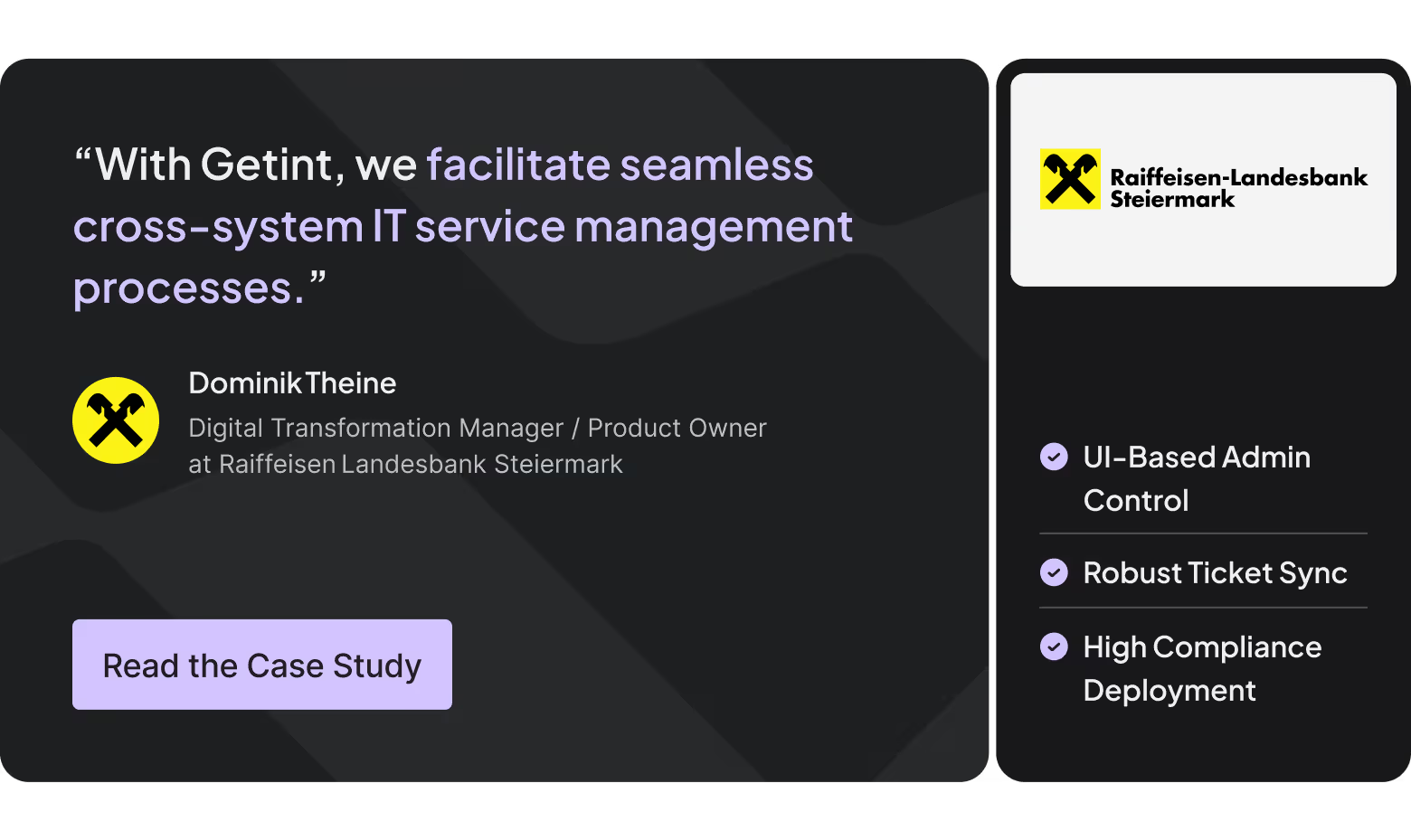
By supporting controlled two-way synchronization, field-level mapping, conflict handling, and detailed logging, Getint helps teams keep data up-to-date across tools without relying on manual data entry or brittle scripts. These capabilities are supported by enterprise-grade security standards, including SOC 2 Type II, GDPR & CCPA, and ISO 27001 and ISO 27018 compliance.

Data Synchronization in Enterprise Workflows
In enterprise environments, data synchronization turns fragmented tools into unified workflows. Development teams, IT support, service owners, and operations rely on synchronized data to collaborate across platforms without duplication or silos.
This includes synchronizing work items between development tools, sharing incident data between ITSM and engineering systems, keeping customer data aligned across support and CRM platforms, feeding analytics pipelines, and bridging systems during migrations or hybrid transitions.
As environments scale, synchronization must handle high data volumes, multiple users, and continuous change — making it a core operational capability rather than a background task.
Development and DevOps Workflows
Development teams often juggle platforms like Jira, GitLab, Azure DevOps, or Monday.com. Synchronizing work items — such as issues, tasks, and pull requests — ensures epics created in Jira appear instantly in GitLab for code assignment, with comments and status updates flowing back bidirectionally. This eliminates manual data entry, where a developer updating a ticket status in one tool leaves the other outdated. Jira GitLab integration can solve many problems perceived before as communication errors.
ITSM and Incident Management
IT support thrives on sharing incident data between ITSM tools like ServiceNow and engineering platforms. When a critical alert hits ServiceNow, bi-directional sync pushes it to Jira as a high-priority ticket, including logs, assignees, and resolution notes. Engineering updates trigger automatic closure in ITSM, maintaining data consistency.
Sales, Marketing, and Customer Operations
Keeping customer data aligned across CRM (Salesforce), support (Zendesk), and marketing automation platforms (HubSpot) prevents silos. Sync customer contacts, support tickets, and purchase history bidirectionally: A new deal in Salesforce updates HubSpot segments for targeted campaigns, while Zendesk escalations flag churn risks back to sales.
Analytics and Reporting Pipelines
Operations teams feed data warehouses like Snowflake or BigQuery from multiple systems via unidirectional sync. Incidents from ServiceNow, metrics from Datadog, and user events from Amplitude converge for dashboards. ETL in the synchronization process cleans incoming data, using primary key values to upsert records without duplicates.
Platform Migrations and Hybrid Transitions
Migrations demand synchronization as a bridge. Syncing Jira Cloud with Data Center during cutover lets teams operate across both, with version control for attachments and file synchronization for distributed file systems. Rules handle one-way initial loads then switch to bi-directional, minimizing downtime.
Overcoming Scale in Multi-Tool Ecosystems
Enterprises face data synchronization challenges like latency in real time synchronization or conflicts from multiple users. Solutions include asynchronous data updates for resilience, error handling with retries, and monitoring for schema drift. Integration platforms like Getint abstract this, offering field-level mapping, CDC, and logging for flows of ongoing processes.
Quantified impact: Teams commonly report substantially less manual intervention, improved data quality, and fewer disruptions — especially in regulated sectors where sync ensures sensitive data compliance
By embedding data synchronization into workflows, enterprises achieve consistent data as a foundation— not afterthought — fueling agile operations amid growing data volumes and tool sprawl.
Conclusion: Data Synchronization as a Long-Term Capability
Data synchronization is not something that can be set up and forgotten. As systems evolve, workflows change, and new tools are introduced, synchronization rules must adapt.
Organizations that treat data synchronization as a long-term capability — with monitoring, ownership, and governance — maintain higher data quality, fewer discrepancies, and greater trust in their systems.
In a world of distributed software and specialized platforms, data synchronization remains one of the most important foundations for reliable operations.