
Project management is one of those disciplines that almost every company relies on, yet few define clearly. Teams “run projects” every day — launching products, building software, delivering services, migrating data, or managing change — but without a shared understanding of what project management actually involves, those efforts often become reactive, fragmented, and difficult to control.
At its core, project management exists to answer a simple but critical question: how do you reliably turn an idea into a successful outcome? As projects grow more complex, teams become more distributed, and work spans multiple tools and stakeholders, the need for structured project management becomes unavoidable.
This guide explains what project management process is, how it works, and why it plays such a central role in delivering successful projects across industries — from software development and construction to marketing, operations, and enterprise transformation. Let's get right into it.
What Is Project Management?
In general, project management is the structured practice of planning, organizing, executing, and controlling work to achieve specific objectives within defined constraints such as time, cost, project scope, and quality.
A project itself, on the other hand, is a temporary project team effort undertaken to create a unique product, service, or result. Unlike ongoing operational work, projects are time-bound: they have a defined beginning, a clear end, and a specific outcome they are meant to deliver. Because of this temporary and goal-driven structure, projects require a different approach to management than routine business activities.
And project management provides that approach. It establishes a framework that helps teams define what project success looks like, plan how to get there, coordinate people and resources, track project costs, monitor progress, and adapt when conditions change. Without this framework, projects tend to drift — deadlines slip, project costs grow, and expectations diverge.
In practice, project management is used across a wide range of contexts, including software development, product launches, internal process improvements, and large-scale organizational initiatives. While the tools and methodologies may differ, the underlying purpose remains the same: to deliver a successful project in a controlled and predictable way.

Why Is Project Management Important? Key Aspects
First and foremost, project management is important because modern work is inherently detailed. Projects rarely involve a single team working in isolation. Instead, they bring together multiple stakeholders, cross-functional teams, external partners, and often multiple systems or tools.
Without project management, organizations frequently encounter the same problems:
- Projects exceed their planned budget and timeline
- Teams lack visibility into project progress
- Responsibilities and ownership are unclear
- Risks are identified too late, when mitigation is costly
- Stakeholder expectations diverge over time
Effective project management process addresses these challenges by introducing structure and discipline throughout the entire project. It enables teams to align around shared goals, anticipate risks, make informed decisions, and track progress in a transparent way.
At an organizational level, strong project management practices also support project portfolio management, allowing leaders to evaluate which projects to prioritize, how to allocate resources, and how to balance short-term delivery with long-term strategy.
Managing Projects vs. Ongoing Operations
To understand project management, it’s important to distinguish projects from ongoing operations.
Operations are continuous and repetitive activities that keep the organization running — such as customer support, system maintenance, or routine reporting. Projects, on the other hand, are temporary and focused on change. They introduce something new: a product, a system, a process, or an improvement.
Project management focuses exclusively on these temporary initiatives. Its role is to ensure that change is delivered deliberately, without disrupting ongoing operations, and that once the objective is achieved, the project is formally closed.
This distinction becomes especially important in large organizations, where teams often manage dozens of initiatives simultaneously. Without clear project goals, boundaries and management discipline, work quickly becomes blurred and difficult to control.
Core Components of Project Management
Although projects vary widely in size and complexity, most share a common set of management concerns. Project management focuses on balancing these elements throughout the entire project life cycle.
Every project must define:
- what will be delivered (scope),
- when it will be delivered (timeline), and
- at what cost (project budget).
These three dimensions are closely connected: a change in scope affects timelines and costs, and delays often increase budget pressure.
Beyond these fundamentals, project management also addresses quality, risk, and communication. Quality ensures that deliverables meet agreed standards, risk management prepares teams for uncertainty, and structured communication keeps stakeholders aligned as the project evolves.
A proficient project manager continuously monitors these elements, making trade-offs when necessary to keep the project on track and aligned with its objectives.
Project Manager Responsibilities
The project manager plays a central role in coordinating work across the entire project. Rather than executing every task, the project manager focuses on planning, alignment, and control.
In practice, a project manager oversees:
- Definition of project goals and success criteria
- Development and maintenance of the project plan
- Coordination of team members and resources
- Monitoring project progress and performance
- Identification and management of project risks
- Communication with project stakeholders
In large projects, having a dedicated project manager significantly increases the likelihood of successful project completion. The role provides a single point of accountability and helps ensure that decisions are made with a clear understanding of the broader project context.
Project Management Lifecycle
Most project management approaches organize work into a structured lifecycle that guides a project from start to finish. While terminology varies across methodologies and standards — including those defined by the Project Management Institute (PMI) and the International Project Management Association (IPMA) — the underlying phases are remarkably consistent.
The project lifecycle exists to bring order to complexity. It ensures that project teams invest time in defining objectives before execution begins, track progress while work is underway, and formally close the project documentation once objectives are met.
Project Management Lifecycle Overview
Rather than being strictly linear, these phases often overlap. Monitoring and controlling, for example, continues throughout execution, ensuring that deviations are detected early and corrective action can be taken.
Why the Lifecycle Matters
Following a structured project lifecycle helps organizations avoid common pitfalls such as unclear objectives, uncontrolled scope changes, and late-stage surprises. It provides a shared mental model for everyone involved in the project — from team members to executives — and creates a repeatable foundation for managing projects.
As projects become larger, more distributed, and more interconnected with other systems and teams, this structure becomes even more valuable.
Project Management Techniques and Approaches
While the core principles of project management remain consistent, the way teams plan and execute projects can vary significantly. Over time, different project management methodologies and approaches have emerged to address different types of work, levels of uncertainty, and organizational needs.
Choosing the right approach is not about following trends — it’s about matching the methodology to the nature of the project, the team’s maturity, and the business context.
Predictive (Traditional) Project Management
Predictive project management, often referred to as Waterfall, follows a linear and sequential structure. The project is planned in detail upfront, and each phase is completed before the next begins.
This approach works best when:
- Project requirements are well defined from the start
- Changes are minimal or tightly controlled
- Project deadlines and budgets must be fixed
Predictive project management is commonly used in construction project management, infrastructure initiatives, and regulated environments where documentation, approvals, and predictability form a critical path.
However, in fast-changing environments, this approach can become rigid. When assumptions change, adapting the project plan often requires significant rework.
Agile Project Management
Agile project management was developed to address environments where change is expected rather than avoided. Instead of detailed upfront planning, agile focuses on iterative delivery, continuous feedback, and incremental improvement.
In agile project management:
- Work is delivered in short cycles
- Requirements evolve based on feedback
- Teams prioritize collaboration and adaptability
This approach is especially common in software development and agile software development, where user needs, technology, and priorities can change quickly.
Rather than attempting to define the entire project in advance, agile teams focus on delivering value early and adjusting direction as they learn.
In practice, many teams apply agile project management using specialized tools that support iterative planning, backlog management, and continuous delivery. Platforms like Jira are widely used to manage agile workflows, boards, and templates across software development teams — a topic we explore in more detail in our guide to agile project management in Jira.
This makes agile particularly effective for multi-stage projects where uncertainty is high and learning is continuous.
Hybrid Project Management
In reality, many organizations do not operate purely in predictive or agile modes. Instead, they adopt hybrid model, combining elements of both approaches like:
- Predictive planning for high-level milestones and budgets
- Agile execution for delivery and implementation
- Formal governance combined with flexible team workflows
Hybrid project management is increasingly common in large organizations where different departments — such as IT, operations, and compliance — must work together under shared constraints.
This approach allows teams to balance structure with adaptability, making it suitable for large and complex projects that span multiple disciplines.
Lean and Six Sigma Project Management
Lean project management focuses on maximizing value while minimizing waste. It emphasizes flow efficiency, continuous improvement, and removing activities that do not contribute to project objectives.
Six Sigma project management, on the other hand, concentrates on quality and consistency by reducing variation and defects. It is often applied in environments where precision and repeatability are crucial. We can highlight 5 key phases that are building this approach (DMAIC).

Both approaches are frequently used to support continuous improvement initiatives, particularly in manufacturing, operations, and process optimization projects.
How Methodologies Support Project Success
No single project management methodology guarantees success. What matters is how well the chosen approach aligns with:
- Project goals and constraints
- Team capabilities
- Organizational culture
- Stakeholder expectations
Successful project management often involves adapting methodologies rather than applying them rigidly. Experienced project managers adjust processes, techniques, and tools to fit the reality of the project — not the other way around.
Project Management Roles and Team Structure
As we already know, project management is not a solo activity. Project manager manages the project plan from initiation through closure but the whole process relies on strong collaboration between multiple roles, each contributing to the success of the project in different ways.
Clear role definition is especially important in large or distributed teams, where ambiguity can quickly lead to delays and misalignment.
Project Team Members
Project team members are responsible for executing the work defined in the project plan. They contribute technical expertise, domain knowledge, and hands-on effort.
Effective project management ensures that team members:
- Understand their responsibilities
- Have clear priorities
- Can collaborate efficiently
- Receive timely feedback
Strong coordination between the project manager and the entire team is essential for maintaining momentum and quality.
Project Stakeholders and Sponsors
Project stakeholders include anyone with an interest in the project’s outcome — from end users and customers to executives and external partners.
Sponsors play a particularly important role. They provide strategic direction, secure resources, and support decision-making when trade-offs are required.
Managing stakeholder expectations is a critical aspect of successful management, especially in large initiatives where interests may conflict.
Project Management Beyond a Single Project
As organizations mature, project scope management expands beyond individual initiatives into broader structures.
This includes:
- Project portfolio management, which focuses on selecting and prioritizing the right projects
- Standardized project management practices and templates
- Governance models that support consistency and transparency
At this level, project management becomes a strategic capability. It enables organizations to align execution with long-term goals and manage change systematically across the entire business.
Common Project Management Challenges
Even with well-defined methodologies and experienced project management professionals, managing projects remains inherently challenging. As projects grow in size, involve more stakeholders, and span multiple systems or organizations, the risk of failure increases — not because teams lack effort, but because complexity compounds quickly.
Understanding the most common project management challenges helps explain why structured project management practices exist in the first place.
Scope Creep and Changing Requirements
One of the most persistent challenges in project management is scope creep — the gradual expansion of project requirements beyond what was originally agreed.
Scope creep often starts with small, seemingly harmless requests. Over time, however, these additions accumulate and begin to impact the project timeline, budget, and workload. Without strong scope management, teams may continue accepting changes without adjusting expectations or resources.
This challenge is particularly common in complicated projects and software development initiatives, where user feedback and evolving needs are part of the process. Effective project management does not eliminate change, but it introduces mechanisms to evaluate, approve, and manage it deliberately.
Lack of Visibility Into Project Progress
When project progress is not tracked consistently, problems tend to surface late — often when deadlines are already at risk.
Limited visibility can result from:
- Infrequent status updates
- Disconnected tools used by different teams
- Manual reporting that quickly becomes outdated
Project management focuses heavily on monitoring and controlling throughout the project lifecycle. By tracking progress continuously, project managers can identify risks early, adjust plans, and keep stakeholders informed before issues escalate.
Resource Constraints and Competing Priorities
Many organizations manage multiple projects simultaneously, often with shared team members. When priorities are unclear or resources are overcommitted, even well-planned projects can stall.
This challenge becomes more pronounced at scale, where project portfolio management is required to balance workloads, align initiatives with strategy, and prevent burnout. Without visibility across the entire project portfolio, organizations struggle to manage projects consistently.
Risk Management Gaps
Every project carries risk — technical, financial, operational, or organizational. Yet risk management is often treated as a one-time exercise during planning rather than an ongoing discipline.
Effective management treats risk as a continuous concern. Risks are identified early, revisited throughout the project, and actively mitigated. This approach significantly improves the likelihood of project completion, especially in bigger projects.
Communication and Stakeholder Misalignment
Project stakeholders often have different priorities, expectations, and definitions of success. Without structured communication, these differences can lead to confusion, rework, and conflict.
Clear communication is one of the most critical practices. It ensures that decisions are documented, expectations are aligned, and the entire team understands both the current status and the direction of the project.
Project Management in Modern Organizations
Project management today operates in a very different environment than it did even a decade ago. Modern organizations are more distributed, more tool-driven, and more interconnected than ever before.
These changes have reshaped how projects are planned, executed, and monitored.
Remote and Distributed Project Management
Remote project management is now a standard reality for many teams. Projects often involve:
- Team members working across time zones
- External partners or vendors
- Cross-functional collaboration between departments
In this context, informal communication and ad-hoc coordination are no longer sufficient. Project management must rely more heavily on clear documentation, transparent workflows, and shared visibility into project progress.
Successful remote project management emphasizes structure — not bureaucracy — to ensure alignment without constant real-time interaction.
Multiple Tools, One Project
Modern projects rarely exist in a single system. Teams may plan work in one tool, execute tasks in another, and report progress in a third.
For example, software development teams often combine tools for agile management with documentation platforms, testing systems, and support tools. While each tool serves a specific purpose, the fragmentation makes it harder to maintain a single, accurate view of the entire project.
This fragmentation increases the importance of project management as a coordinating discipline — one that focuses on outcomes rather than individual tools.
Agile, Hybrid, and Evolving Ways of Working
Most organizations no longer follow a single project management methodology rigidly. Instead, they adapt their approach based on the type of project, the team involved, and the level of uncertainty.
Agile project management is common in software development and innovation-focused initiatives, while predictive approaches remain relevant in construction projects and regulated environments. Hybrid project management has emerged as a practical response to this diversity, allowing organizations to combine structure with flexibility.
What matters most is not the label of the methodology, but whether the approach supports project objectives and stakeholder expectations.
Project Management Software and Tools
As projects scale across teams, time zones, and functions, project management software becomes a practical necessity. Its role is not to “manage the project for you,” but to reduce operational chaos, improve visibility, and support consistent project execution.
What differentiates project management tools is not how many features they advertise, but how effectively they help teams stay in control — especially when multiple projects, dependencies, and stakeholders are involved.
In practice, tools tend to fall along a spectrum: from lightweight task coordination to highly structured, enterprise-grade systems. Below are several widely used tools, each illustrating a different approach to managing projects.
Commonly Used Project Management Tools (Brief Context)
Rather than comparing features line by line, it’s more useful to understand what kind of project environment each tool naturally supports.
- Monday.com
Known for its visual clarity and ease of use, monday.com is often chosen by teams that want structure without excessive complexity. It scales well from small teams to large organizations and is frequently used to bring order to complex, cross-functional projects.

- ClickUp
Designed as an all-in-one platform, ClickUp combines task management, documentation, dashboards, and automation in a single system. It offers significant flexibility and depth, making it suitable for teams managing complex projects — though it requires discipline to configure effectively.

- Asana
Asana emphasizes accountability, task clarity, and process consistency. It works well in operations-driven environments where structured workflows and progress tracking are priorities, but can feel rigid for more exploratory or creative work.

- Notion
Notion is less prescriptive by design. It allows teams to build their own project management systems by combining documentation, tasks, and databases. This flexibility is powerful, but it depends heavily on thoughtful setup and consistent usage.

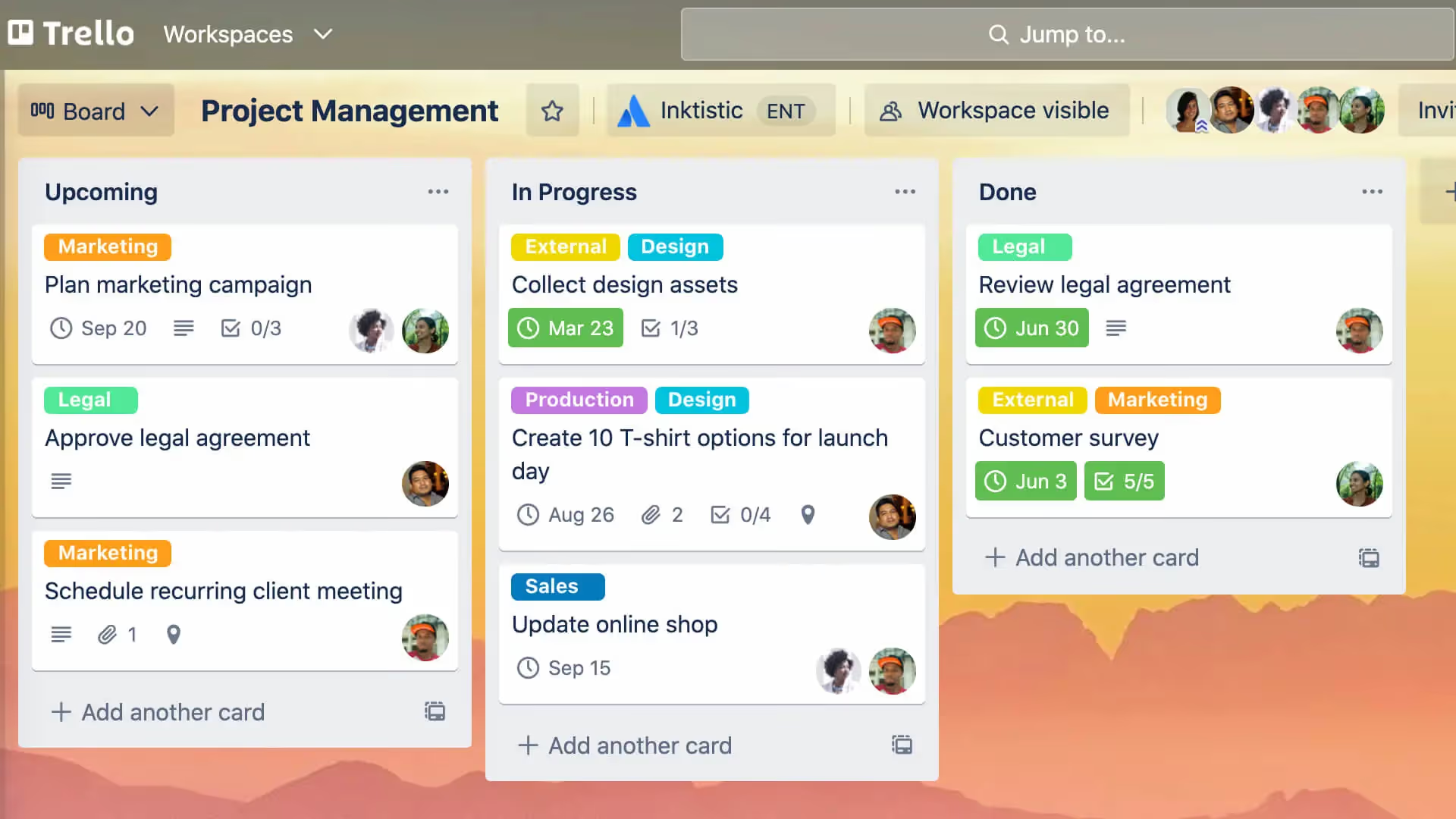
- Trello
Trello offers a simple, intuitive entry point into project management through boards and cards. It is well suited for small teams and straightforward projects, but struggles to support complex dependencies or large, multi-project environments.
- Smartsheet
With a spreadsheet-like interface, Smartsheet appeals to teams accustomed to structured, data-driven planning. It is commonly used in operational and construction project management contexts, where familiarity and predictability matter more than flexibility.

- Jira
Jira is purpose-built for agile software development and issue tracking. It excels in environments where sprint planning, backlogs, and strict workflows are required. Outside of development teams, however, it can feel overly complex and process-heavy for general project management needs but it also provides many project management templates helpful in monitoring and controlling phases.

- Microsoft Project
A long-standing enterprise tool designed for managing detailed schedules, dependencies, and budgets. While powerful, it reflects a more traditional, predictive project management approach and often presents a steep learning curve. - Miro
Miro is not a project management tool in the execution sense, but it plays an important role during early project phases. Teams use it for brainstorming, mapping ideas, and planning collaboratively, especially in remote settings.
Each of these tools reflects a different philosophy: simplicity versus power, flexibility versus structure, customization versus standardization. Choosing between them depends less on popularity and more on project complexity, team maturity, and organizational context.
Kanban Principles as a Tool Capability, Not a Requirement
What’s notable is that Kanban is no longer a standalone choice — it has become a set of principles embedded into how many project management tools work.
Even teams that do not formally practice Kanban often benefit from:
- Visualizing work stages
- Limiting work in progress
- Identifying bottlenecks early
- Improving flow across the project
In this sense, Kanban functions as a practical execution layer within broader project management systems. Tools that support these principles well tend to feel calmer and more predictable, especially when managing multiple projects or distributed teams.
Project Management Tools by Use Case (Overview)
To place these tools in context, it helps to group them by how they are typically used rather than by brand.
This perspective reinforces an important principle: tools support project management, but they do not define it. Without clear objectives, ownership, and processes, even the most sophisticated platform cannot ensure project success.
Tools as Enablers, Not Substitutes
Effective project management focuses first on clarity — of goals, roles, timelines, and expectations. Tools are most valuable when they reinforce that clarity by making work visible, progress measurable, and collaboration easier.
As organizations mature, they often move from simple task tracking toward more integrated tool ecosystems. At that point, project management becomes less about managing individual tasks and more about coordinating work across teams, systems, and stakeholders — a challenge that extends well beyond any single tool.
Project Management Best Practices That Drive Consistent Results
While tools and methodologies vary, successful project management tends to rely on a shared set of practices that remain relevant across industries, team sizes, and project types. These practices help project managers and teams navigate uncertainty, manage complexity, and deliver results reliably.
Clear project definition from the start
Projects that begin without well-defined objectives, scope boundaries, and success criteria often struggle later, regardless of how well execution is managed. Strong project initiation documentation provides alignment early and serves as a reference point throughout the project lifecycle.
Continuous planning rather than one-time planning
Even in predictive project management, assumptions made early may change as new information emerges. Qualitative project management treats the project plan as a living artifact, updated as risks, dependencies, and priorities evolve.
Communication
Successful projects rarely fail due to a lack of effort; they fail because information does not reach the right people at the right time. Regular, structured communication helps manage stakeholder expectations, surface risks early, and maintain alignment across the entire team.
Project monitoring and controlling
It's an active process, not an administrative task. Tracking progress, costs, and risks throughout the project allows teams to adjust before problems escalate and deadlines are missed.
Measuring Project Success
Project success is often misunderstood as simply “delivering on time and on budget.” While these factors matter, they do not fully capture whether a project achieved its intended value.
In practice, successful project management evaluates outcomes across multiple dimensions:
- Whether project objectives were met
- Whether stakeholders are satisfied with the result
- Whether the solution delivers lasting business value
- Whether risks were managed effectively
- Whether the project supports long-term organizational goals
This broader view is especially important for complex projects, transformation initiatives, and software development efforts, where learning and adaptability are part of the process.
Organizations with mature project management practices often define success criteria during initiation and revisit them during closure. This helps teams move beyond task completion and focus on meaningful outcomes.
Project Management Standards and Professional Bodies
Over time, project management has evolved into a recognized professional discipline, supported by global standards, frameworks, and certifications.
- The Project Management Institute (PMI) is one of the most widely known organizations in the field. PMI maintains the Project Management Body of Knowledge (PMBOK), which outlines standardized processes, terminology, and best practices used by project management professionals worldwide.
- The International Project Management Association (IPMA) takes a slightly different approach, emphasizing competence, leadership, and contextual skills alongside technical knowledge. IPMA frameworks are often used in international and cross-cultural project environments.
While these standards do not prescribe a single “correct” way to manage projects, they provide a common language and reference point that supports consistency, professional development, and organizational maturity.
Project Management as an Organizational Capability
As organizations grow, project management expands beyond individual initiatives into a broader capability that shapes how change is delivered.
At this level, project management focuses on:
- Aligning projects with strategic objectives
- Managing dependencies across multiple initiatives
- Balancing resources and priorities through project portfolio management
- Building repeatable processes and templates
- Developing project management professionals
Organizations that invest in these foundations are better equipped to manage large and complex projects, adapt to change, and scale effectively.
Project management, in this context, is not a constraint on creativity or innovation. Instead, it provides the structure needed to turn ideas into outcomes — consistently and predictably.
Final Thoughts: What Project Management Really Focuses On
At its core, project management focuses on one fundamental challenge: how to deliver change successfully.
Whether the project involves building software, managing a construction project, coordinating remote teams, or transforming internal processes, the underlying principles remain the same. Clear objectives, disciplined planning, continuous monitoring, and effective communication form the backbone of successful project management.
As work becomes more distributed, tools more fragmented, and projects more interconnected, the importance of project management continues to grow. It is no longer just a role or a set of templates — it is a critical capability that enables organizations to execute strategy, manage risk, and deliver value.
This is why project management remains central to modern organizations, and why mastering its principles is essential for managing successful projects at any scale.